
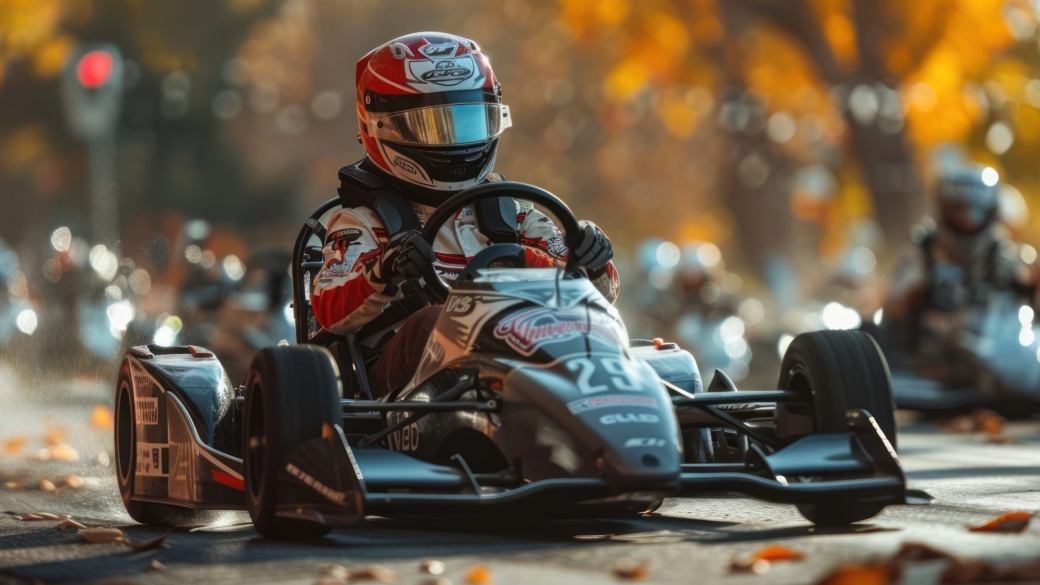
Starting a race from the back of the grid is difficult enough. Starting dead last behind 100 other drivers is something else entirely.
Max Verstappen decided to find out exactly what that would look like.
The Formula 1 champion lined up 101st in a massive go-kart event at Silverstone, with 100 drivers between him and the lead. Fourteen laps later, every single one of those drivers was behind him.
The unusual event, organized as part of Red Bull’s “Max vs. 100” challenge, transformed the Silverstone circuit into a chaotic experiment in racing, traffic management, overtaking, and driver skill.
Verstappen completed the full charge in 35 minutes, reaching the final driver on lap 14 of a scheduled 30-lap run. His fastest lap was 2 minutes, 20.673 seconds, giving the event an unexpectedly clear demonstration of just how much difference an elite driver can make when everyone is using similar equipment.
Starting From the Worst Possible Position
The challenge began with Verstappen in 101st place.
Ahead of him were a diverse group of drivers, including Red Bull athletes, content creators, professional and amateur racers, journalists, streamers, and fans. Many had limited experience with the temporary circuit layout, making the opening stages of the event particularly unpredictable.
The first lap immediately demonstrated how difficult the format would be.
More than 10 drivers were passed before Verstappen even reached the start-finish line. With more than 100 karts fighting for space, the field quickly became congested, particularly through slower corners.
Several drivers collided or spun, while others struggled to find clean racing lines through the traffic.
By the time Verstappen had completed his opening lap, dozens of competitors had already been eliminated from the event.
What initially looked like a simple challenge—start last and work forward—quickly became a constantly changing puzzle.
The Race Quickly Descends Into Chaos
A field of 101 karts creates problems that simply do not exist in a conventional race.
Drivers have limited visibility, braking zones become crowded, and a small mistake can affect several competitors at once. With so many vehicles concentrated on a relatively compact circuit, avoiding incidents becomes almost as important as finding opportunities to pass.
Verstappen immediately found himself navigating through a constantly shifting environment.
The event’s unusual rules also changed the meaning of an overtake. Once Verstappen’s rear wheels drew level with the front wheels of another kart, the pass was considered complete and that driver’s run effectively ended.
That meant every position gained had immediate consequences.
There was little room for hesitation.
Verstappen’s Advantage Became Clear
As the race developed, Verstappen began making up positions at a remarkable rate.
While much of the field was slowed by incidents and traffic, he was able to identify openings before they fully developed. Instead of waiting for a large gap, he often committed to a move while the opportunity was still forming.
That is one of the skills that separates experienced professional drivers from competitors who may be fast but have less experience managing unpredictable traffic.
The result was a steady climb through the field.
By the middle portion of the event, only a small group of drivers remained ahead of Verstappen. Three leaders had managed to establish a gap, but that advantage was steadily disappearing.
Verstappen was gaining several seconds per lap.
The Leaders Try to Hold Him Off
The leading group consisted of Jacky Martens, Zac Alsop, and Lewis Osler.
They had managed to stay ahead while much of the field behind them became tangled in incidents, but Verstappen’s pace was making the gap increasingly difficult to defend.
The event organizers even gave the leading drivers an additional fast lap as the challenge entered its later stages.
The move temporarily gave the leaders another opportunity to extend their advantage, but it could not change the fundamental difference in pace.
Verstappen continued closing the gap.
Once he reached the leading group, the final stage happened quickly.
He passed two of the remaining drivers in a single corner before eventually getting by Martens, the final competitor standing between Verstappen and the front of the field.
After starting 101st, Verstappen had officially passed all 100 rivals.
The Numbers Tell Part of the Story
Verstappen completed the challenge in approximately 35 minutes.
His fastest lap was recorded at 2:20.673, more than two and a half seconds quicker than Martens’ best lap.
Those numbers provide an interesting reference point because the event was designed around relatively standardized equipment.
The challenge was not simply about having access to a faster race car.
Instead, it placed a highly experienced professional driver into an environment where traffic, positioning, timing, and racecraft became extremely important.
The result highlighted how much performance can come from the person controlling the vehicle.
A Very Different Podium
The final results also created an unusual mix of experience levels.
Martens, Osler, and Alsop finished alongside Verstappen, putting experienced competitors and everyday racing enthusiasts on the podium next to a four-time Formula 1 world champion.
Other notable finishers included off-road motorcycle rider Pol Tarrés, streamer RDJavi, photographer Larry Chen, mountain biker Bernard Kerr, and actor Neo Yau.
The variety of participants was part of what made the event different from a conventional professional race.
Everyone entered with different backgrounds, levels of experience, and reasons for taking part.
Yet once the karts hit the circuit, the same basic variables applied to everyone: braking, acceleration, positioning, reaction time, and decision-making.
Designing a Track for 100 Karts
The circuit itself presented another engineering challenge.
Race director and track designer David Terrien created the layout specifically with a very large field in mind. With more than 100 karts sharing the circuit, the track needed enough variation to create passing opportunities while also providing places where drivers could safely navigate the inevitable congestion.
That made the event as much an experiment in race design as it was a test of driving ability.
A traditional circuit designed for a small field might become almost unusable with 100 karts.
The temporary Silverstone layout instead provided a setting where drivers could repeatedly encounter new situations as the field changed around them.
Why Verstappen’s Driving Stood Out
The most revealing part of the challenge was not necessarily the final number of overtakes.
It was the way Verstappen approached traffic.
Professional drivers spend years learning how to read situations before they happen. They learn to anticipate where another vehicle will move, where a gap is likely to appear, and how much space will remain after committing to an overtaking maneuver.
That ability becomes especially valuable in a crowded karting environment.
A gap does not necessarily need to exist yet.
Sometimes the advantage comes from recognizing that another driver is about to move, that two karts are likely to separate, or that a corner will create an opening a fraction of a second later.
That kind of anticipation can turn a chaotic situation into a series of manageable decisions.
When the Data Meets the Driver
The event had also been modeled ahead of time, with organizers estimating how long the challenge might take.
The actual result demonstrated how difficult it can be to account for an exceptional driver’s abilities when building a model around a large group of participants.
Simulation and data can provide valuable expectations, but racing remains highly dependent on human decision-making.
A driver can react to circumstances that are difficult to predict mathematically, particularly when those circumstances change from one corner to the next.
Verstappen’s performance became a real-world example of that difference.
More Than a Viral Racing Challenge
At first glance, an event like this might seem designed primarily for entertainment.
And there was certainly plenty of entertainment.
More than 100 karts racing around a compact circuit naturally created plenty of dramatic moments. Drivers spun, collided, defended positions, and attempted to navigate the traffic while Verstappen steadily worked his way forward.
But the event also demonstrated something fundamental about motorsport.
Identical or similar equipment does not necessarily produce identical results.
The driver remains an enormous part of the equation.
Experience, timing, anticipation, spatial awareness, confidence, and the ability to make rapid decisions can dramatically influence what happens on track.
A Different Look at Professional-Level Skill
The “Max vs. 100” challenge created an unusual opportunity to make that difference visible.
In a normal Formula 1 race, the gap between Verstappen and an amateur driver cannot easily be measured because the cars, teams, tires, strategies, and engineering programs are completely different.
Here, the environment was much simpler.
The field was enormous, the equipment was more standardized, and Verstappen had to work through traffic rather than simply drive away from a starting position.
That made the event an entertaining but surprisingly useful demonstration of racecraft.
Starting from 101st and reaching the final competitor on lap 14 required far more than raw speed.
It required knowing where to position the kart, when to commit, how to avoid unnecessary risks, and how to recognize opportunities before they disappeared.
The Final Lesson From Silverstone
By the end of the challenge, Verstappen had passed all 100 drivers and completed the run in 35 minutes.
The numbers are impressive, but the larger story is what happened between the start and finish.
A crowded grid turned the circuit into a constantly moving puzzle. Drivers with very different levels of experience were forced to react to one another, while Verstappen steadily found a way through the traffic.
The event may have been created as a spectacular racing challenge, but it also offered a glimpse into the difference that elite racecraft can make.
Give a world-class driver a kart, a crowded circuit, and a seemingly impossible starting position, and the result can be very different from what the starting grid suggests.
At Silverstone, 100 drivers stood between Verstappen and the lead.
Fourteen laps later, none of them did.